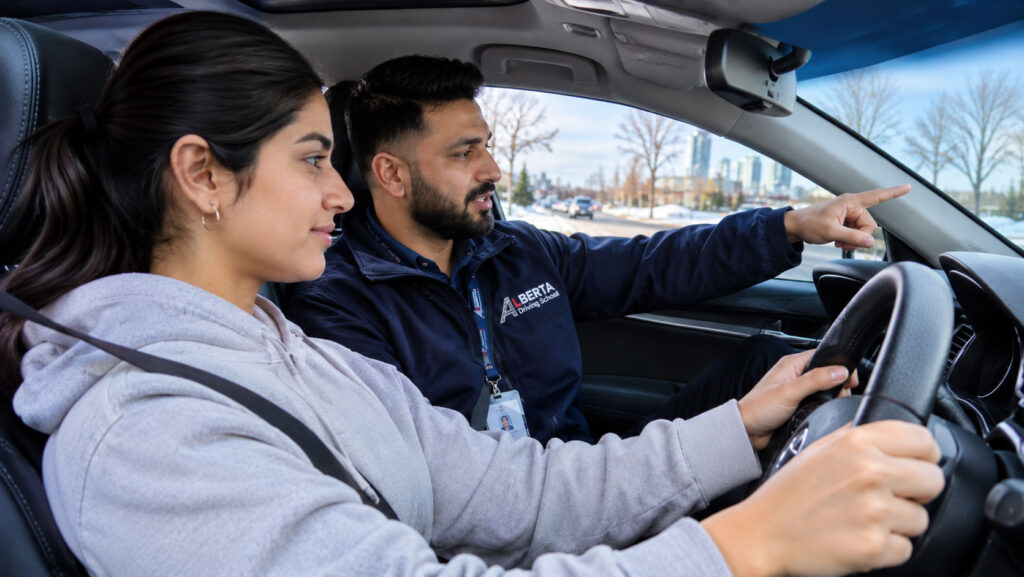
Looking for Driving Classes in Edmonton? A Complete Beginner’s Guide to Learning Safe Driving with Alberta Driving School
Why Are Driving Classes Important for Beginners in Edmonton?
Learning to drive is an important milestone. It gives you greater independence, makes commuting easier, and opens up new opportunities for work, education, and everyday activities. However, becoming a confident driver involves much more than learning how to start a vehicle, use the steering wheel, and press the accelerator.
For beginners, driving in Edmonton can feel challenging at first. You need to understand traffic signs, follow Alberta’s road rules, navigate busy intersections, manage lane changes, practise parking, and adjust to changing weather conditions. Developing these skills takes patience, consistent practice, and proper guidance.
If you are searching for Driving Classes Edmonton, choosing a structured learning programme can help you develop safe driving habits from the beginning. Professional instruction gives you an opportunity to practise real-world driving situations while receiving guidance and feedback.
At Alberta Driving School, learners can explore different driver education packages designed around their training needs, including in-car instruction and classroom or online learning options. Whether you are a first-time driver or someone looking to improve existing skills, the right training can help you approach driving with greater confidence.
This beginner’s guide explains what to expect from driving classes, how to prepare for your first lesson, which essential skills you should develop, and how to take your next steps towards becoming a responsible driver in Alberta.
2. What Are Driving Classes and Why Should Beginners Consider Them?
Driving classes are structured learning sessions that help individuals understand vehicle operation, traffic regulations, road safety, and practical driving techniques.
For someone who has never driven before, professional instruction provides a more organised learning experience than trying to understand everything independently.
A well-planned driving education programme generally combines theoretical knowledge with practical, behind-the-wheel experience.
Benefits of Taking Professional Driving Classes
Here are some important reasons beginners should consider professional driving instruction:
1. Learn correct driving techniques
Beginners can learn essential vehicle controls, steering techniques, braking, acceleration, mirror adjustments, and safe positioning.
2. Understand traffic rules
Learning Alberta’s traffic laws helps you recognise road signs, understand right-of-way rules, follow speed limits, and make safer decisions.
3. Develop confidence gradually
Instead of immediately facing complicated traffic situations, learners can progress from basic vehicle control to more challenging driving environments.
4. Identify and correct mistakes
An instructor can identify habits that need improvement, such as incorrect mirror checks, improper turning techniques, or inconsistent speed control.
5. Build long-term road safety habits
Good driving habits developed early can help reduce risks and make everyday driving more predictable.
The Government of Alberta recommends professional training through licensed driving schools because formal instruction helps new drivers develop the knowledge and skills required to become responsible road users. Alberta.ca
3. What Will You Learn in Driving Classes in Edmonton?
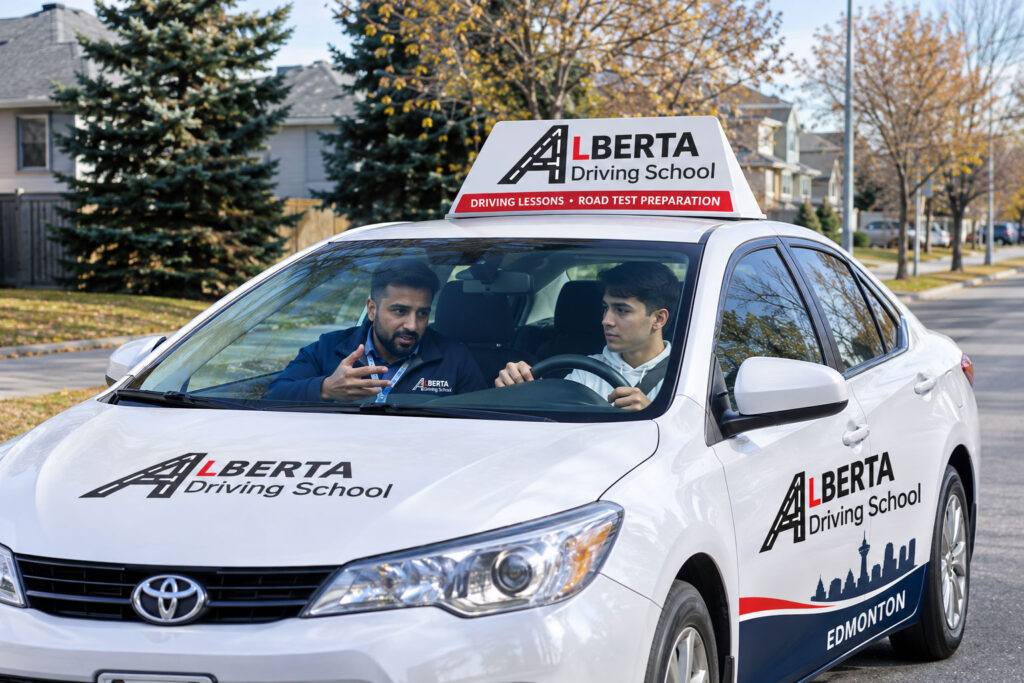
If you are enrolling in beginner driving classes, you should expect to develop several important skills. The exact lesson structure depends on your selected course and individual learning progress.
Here are some essential areas of driver education.
A. Understanding Vehicle Controls
Before driving on public roads, beginners need to understand how a vehicle operates.
Your initial lessons may introduce you to:
- Steering wheel positioning and control.
- Accelerator and brake pedals.
- Gear selection and vehicle controls.
- Turn signals and headlights.
- Windshield wipers and defrosting systems.
- Seat adjustments and seatbelt use.
- Rear-view and side-mirror adjustments.
- Dashboard indicators and warning lights.
Understanding these controls makes it easier to concentrate on the road rather than searching for vehicle functions while driving.
B. Starting, Stopping and Controlling the Vehicle
Smooth vehicle control is one of the most important skills for a beginner.
You will need to understand how to accelerate gradually, maintain appropriate speed, brake smoothly, and bring the vehicle to a complete stop.
For example, when approaching a red traffic light, you should identify the intersection early, check surrounding traffic, reduce your speed smoothly, and stop at the appropriate stopping position.
C. Steering and Lane Positioning
Maintaining the correct lane position is essential when driving through Edmonton’s residential streets, main roads, and intersections.
Beginners should practise:
- Maintaining a steady position within their lane.
- Making controlled left and right turns.
- Checking mirrors regularly.
- Performing shoulder checks before changing lanes.
- Maintaining safe following distances.
- Understanding lane markings and road signs.
These techniques help you become more aware of other road users.
D. Parking Techniques
Parking can be one of the most challenging parts of learning to drive.
A beginner driving programme may include practice with:
- Angle parking.
- Perpendicular parking.
- Parallel parking.
- Reversing into parking spaces.
- Safe vehicle positioning.
The key is to practise slowly, observe your surroundings, use mirrors correctly, and avoid rushing through manoeuvres.
E. Defensive Driving Skills
Defensive driving means anticipating possible hazards and making decisions that help prevent collisions.
For example, if a vehicle ahead suddenly brakes, maintaining an appropriate following distance gives you more time to respond.
Important defensive driving habits include:
- Scanning the road ahead.
- Checking blind spots.
- Watching for pedestrians and cyclists.
- Anticipating sudden traffic movements.
- Adjusting speed to road conditions.
- Avoiding distractions while driving.
These skills are particularly valuable for beginners who are still developing their road awareness.
4. Understanding Alberta’s Driving Licence System
Before enrolling in driving classes, beginners should understand the basic licensing process in Alberta.
The province uses a Graduated Driver Licensing (GDL) system to help new drivers develop experience before obtaining a full, non-GDL Class 5 licence.
Step 1: Obtain a Class 7 Learner’s Licence
The Class 7 licence is the starting point for most new drivers.
According to the Government of Alberta, applicants must:
- Be at least 14 years old.
- Pass a driver knowledge test.
- Pass a vision test.
- Obtain parental or guardian consent if under 18.
A Class 7 learner must drive a Class 5 vehicle with an accompanying driver who is at least 18 years old and holds a full Class 5 licence. Learner restrictions also include no driving between midnight and 5 a.m. and a zero-alcohol requirement. Alberta.ca
Step 2: Gain Driving Experience
Once you have your learner’s licence, you can begin practising under the required supervision.
This is an important stage because it allows you to apply what you have learned during professional driving lessons.
Focus on developing consistent habits, including:
- Checking mirrors before manoeuvres.
- Maintaining safe distances.
- Following traffic signs.
- Controlling your speed.
- Practising different parking techniques.
Step 3: Apply for a Class 5-GDL Licence
To qualify for a probationary Class 5-GDL licence, you generally need to:
- Be at least 16 years old.
- Hold a Class 7 learner’s licence for at least 12 months.
- Pass the Class 5 road test.
- Meet the applicable identification, residency, and consent requirements.
Step 4: Progress Towards a Full Class 5 Licence
The full Class 5 non-GDL licence is the next stage.
Generally, drivers must be at least 18 years old, complete 24 months in the probationary stage, and remain suspension- and demerit-free during the final 12 months.
Eligible drivers may reduce the probationary period by up to six months by completing qualifying driver training. Check the current provincial requirements before making licensing decisions. Alberta.ca+1
Important: Driver education is valuable preparation, but completing a driving course does not automatically provide a driver’s licence or guarantee that you will pass your road test.
5. How to Choose the Right Driving Classes in Edmonton
Not every beginner has the same learning requirements. Some students have never sat behind the steering wheel, while others understand the basics but need more practical experience.
Before selecting a driving course, consider the following factors.
A. Check the Course Structure
Look for a programme that combines practical driving instruction with theoretical education where appropriate.
Alberta Driving School currently lists packages with different amounts of in-car training, including 10, 14, 18 and 20 hours, alongside classroom or online learning options in selected packages. Alberta Driving School
B. Consider Your Current Driving Experience
Your experience should influence the amount of training you need.
- Complete beginners: Start with basic vehicle controls and fundamental driving techniques.
- Learner’s licence holders: Focus on practical experience and improving road awareness.
- Nervous drivers: Build confidence gradually through structured practice.
- Road test candidates: Concentrate on manoeuvres, observation, decision-making and areas requiring improvement.
C. Understand the Total Course Cost
Before registering, check what is included in the package.
Ask about:
- Total in-car training hours.
- Classroom or online learning hours.
- Pickup and drop-off arrangements.
- Additional lesson charges.
- Cancellation and refund policies.
- Course completion documentation.
The Government of Alberta recommends reviewing training hours, rates, additional charges and refund policies before choosing a driving school. Alberta.ca
D. Check the School’s Service Area
Convenience matters when arranging regular lessons. Alberta Driving School lists course options for West Edmonton, North Edmonton, Mill Woods and nearby communities, along with locations such as St. Albert, Sherwood Park, Leduc, Beaumont and Spruce Grove. You can review the available packages and service locations on the Alberta Driving School Courses page.
6. Driving Challenges Beginners Should Prepare for in Edmonton
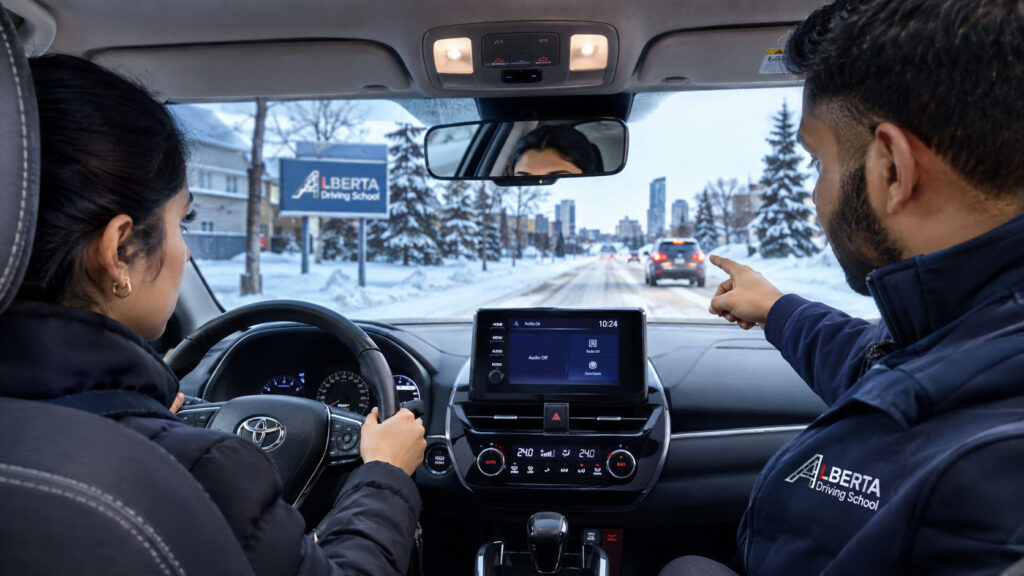
Driving in Edmonton requires learners to adapt to different traffic conditions, road layouts and seasonal weather. Here are some common challenges beginners should understand.
A. Driving During Rush Hour
Busy traffic can be stressful for inexperienced drivers. During peak commuting periods, you may encounter frequent lane changes, sudden braking, merging traffic and congested intersections. Beginner tip: Practise maintaining a safe following distance, checking mirrors regularly and anticipating traffic movements. Avoid sudden acceleration or unnecessary lane changes.
B. Navigating Intersections
Intersections require careful observation and decision-making. You should understand traffic signals, stop signs, turning rules, pedestrian crossings and right-of-way requirements. Beginner tip: Slow down appropriately, observe the intersection, check for pedestrians and cyclists, and proceed only when it is safe and legally permitted.
C. Driving in Winter Conditions
Edmonton winters can bring snow, ice, reduced visibility and slippery road surfaces. New drivers should understand how these conditions affect braking distance and vehicle control. Important winter driving habits include:
- Reduce speed according to road and weather conditions.
- Increase following distance.
- Avoid sudden braking and sharp steering.
- Clear snow and ice from windows, mirrors, lights and the vehicle.
- Use appropriate winter tyres and maintain proper tyre pressure.
- Allow extra time to reach your destination.
Winter driving requires additional care, even for experienced drivers. Beginners should practise under appropriate supervision and avoid unnecessary trips during severe weather.
D. Highway and Multi-Lane Road Driving
Driving on larger roads requires awareness of traffic speed, merging, lane positioning and safe following distances. Beginners should first become comfortable with basic vehicle control before progressing to more demanding road environments. An instructor can help identify when you are ready to practise more complex situations.
7. Common Mistakes Beginners Should Avoid
Making mistakes is part of learning, but identifying and correcting them early is essential.
Here are some common beginner driving mistakes.
| Common mistake | How to improve |
|---|---|
| Forgetting mirror checks | Develop a consistent observation routine. |
| Not checking blind spots | Perform shoulder checks before changing lanes. |
| Braking suddenly | Anticipate traffic and slow down gradually. |
| Driving too close to another vehicle | Maintain an appropriate following distance. |
| Incorrect lane positioning | Pay attention to road markings and steering control. |
| Rushing parking manoeuvres | Practise slowly and observe your surroundings. |
| Getting distracted | Keep your attention on driving and avoid phone use. |
One important lesson for every beginner is that safe driving is not about speed. It is about awareness, patience, judgement and consistency.
8. How Alberta Driving School Can Help You Learn
Choosing a suitable driving school is an important step towards developing responsible driving habits.
Alberta Driving School provides driving education packages with practical in-car instruction and classroom or online learning options.
The available courses are designed around different training-hour requirements, giving learners options to consider based on their experience and learning needs.
Here are some reasons to explore its programmes:
- Different training packages: Review options with different practical driving hours.
- Flexible learning formats: Selected packages include classroom or online theory learning.
- Multiple service locations: Explore courses in Edmonton and listed surrounding communities.
- Pickup and drop-off options: Several listed packages include pickup and drop-off.
- Beginner-focused learning: Build your understanding of vehicle control and road safety through practical instruction.
The school also provides course information and registration options through its website.
Visit Alberta Driving School to explore the available programmes and find a suitable starting point for your driving journey.
9. Tips to Get the Most Out of Your Driving Lessons
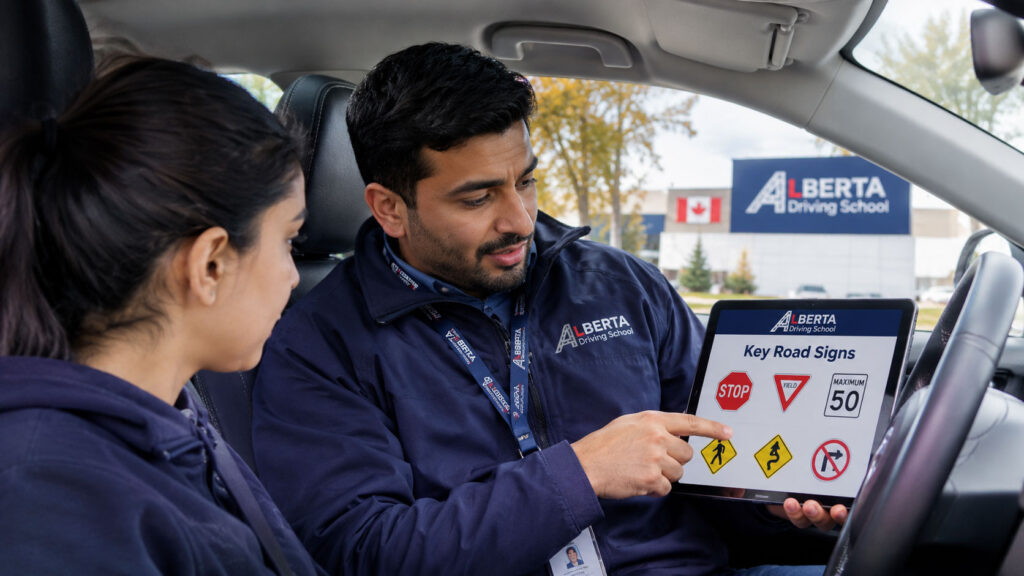
Enrolling in driving classes is only the beginning. Your preparation and attitude during each lesson can make a meaningful difference.
Follow these practical suggestions:
1. Review traffic rules before your lesson.
Read the Alberta Driver’s Guide to understand road signs, traffic regulations and safe driving practices.
2. Listen carefully to your instructor.
Pay attention to demonstrations, corrections and explanations. Ask questions whenever something is unclear.
3. Practise consistently.
With the legally required supervision, regular practice can help reinforce the skills you learn during lessons.
4. Focus on one skill at a time.
Do not try to master every driving manoeuvre in one session. Improve gradually.
5. Learn from mistakes.
Ask your instructor what went wrong and how you can improve during your next attempt.
6. Develop patience and confidence.
Every driver progresses differently. Focus on becoming safe and consistent rather than comparing your progress with others.
10. Frequently Asked Questions About Driving Classes in Edmonton
1. How do I find the right driving classes in Edmonton?
Look for a driving school that offers structured practical instruction, suitable training packages, clear pricing and convenient lesson arrangements. Check its available locations and course details before registering. Beginners should choose training that matches their current experience and learning requirements.
2. Can complete beginners enrol in driving classes in Edmonton?
Yes. Beginner driving education is intended to help new drivers understand vehicle controls, road signs, traffic rules and practical driving techniques. You must hold the appropriate licence and follow Alberta’s learner driving requirements before practising on public roads.
3. How many driving lessons do I need before taking my road test?
There is no single number of lessons that works for everyone. It depends on your previous experience, learning progress, vehicle control and ability to make safe driving decisions. Your instructor can help assess your readiness, but you must also meet Alberta’s official road test eligibility requirements.
4. Are classroom and online driving courses available in Edmonton?
Alberta Driving School lists packages that combine in-car instruction with classroom or online learning options. Availability and training hours vary by package and location. Visit its courses page to compare the current options.
5. Can adults and newcomers take driving classes in Edmonton?
Yes. Adults and newcomers can benefit from professional driver education. However, newcomers with an existing foreign driving licence should first check Alberta’s licence exchange and eligibility requirements. Depending on their circumstances, they may be able to exchange their licence or receive credit for previous driving experience.
6. Do driving classes guarantee that I will pass the Alberta Class 5 road test?
No. Completing driving classes does not guarantee a passing result. Training can help you improve vehicle control, road awareness and driving techniques, but your road test result depends on your performance and ability to meet the examiner’s requirements.
7. Where can I find driving course packages in Edmonton?
You can explore available packages directly through Alberta Driving School’s Courses page. The website lists different in-car training options and selected classroom or online packages for Edmonton and surrounding communities.
11. Start Your Driving Journey with Confidence
Learning to drive is a valuable life skill that requires patience, responsibility and consistent practice. For beginners, taking professional driving classes can make the learning process more structured and help establish safe habits from the start.
If you are searching for Driving Classes Edmonton, take the time to understand your training requirements, compare available packages and choose a learning programme that supports your goals.
From understanding vehicle controls and practising parking to navigating intersections and preparing for your Class 5 road test, every lesson can bring you closer to becoming a confident and responsible driver.
Ready to start learning?
Explore the available driving courses at Alberta Driving School and take your first step towards safer driving in Edmonton.
Website: https://www.albertadriving.ca/
Call: +1 780-217-5771
Email: albertadriving@hotmail.com